Blog
07 23, 2026
{{ content.title }}
{{ content.description }}
On July 14, 2026, PJM Interconnection released the results of the Base Residual Auction (BRA) for the 2028/2029 delivery year, which runs from June 1, 2028 through May 31, 2029.
The Base Residual Auction serves as a key mechanism for maintaining electric reliability across PJM’s vast footprint, which spans 13 Mid-Atlantic states and Washington, D.C. During the auction, PJM secures commitments from generation, demand response, and other capacity resources in advance of the delivery year, ensuring the region has adequate resources available to meet projected demand and preserve system reliability during periods of grid stress.
The outcome of this auction is a clearing price. Businesses participating in PJM’s demand response program, the Emergency Load Response Program (ELRP), are paid based on this clearing price. For ratepayers, the clearing price directly influences the capacity charges on their electricity bill. In both instances, the auction outcome plays an important role in determining a business’s operational costs.
The results of the 2028/2029 Base Residual Auction
Capacity prices remain at record-high levels across the entire PJM region, and this marks the third consecutive auction to clear at the price cap – the highest possible level. The result: a capacity price of $118,625/MW-year across all zones.
PJM implemented the cap/floor framework in the 2026/2027 auction due to pressure from governors, lawmakers, and consumer advocates. The goal of the framework is to protect ratepayers from extreme price volatility while still encouraging pricing incentives for new generation development and demand response participation. The framework was originally slated for two auctions (2026/2027 and 2027/2028), but in April 2026, FERC approved a 2-year extension. As a result, the 2028/2029 and 2029/2030 auctions would also carry a floor and cap price.
PJM capacity prices remain at record levels for the fourth straight year in the 2028/2029 auction
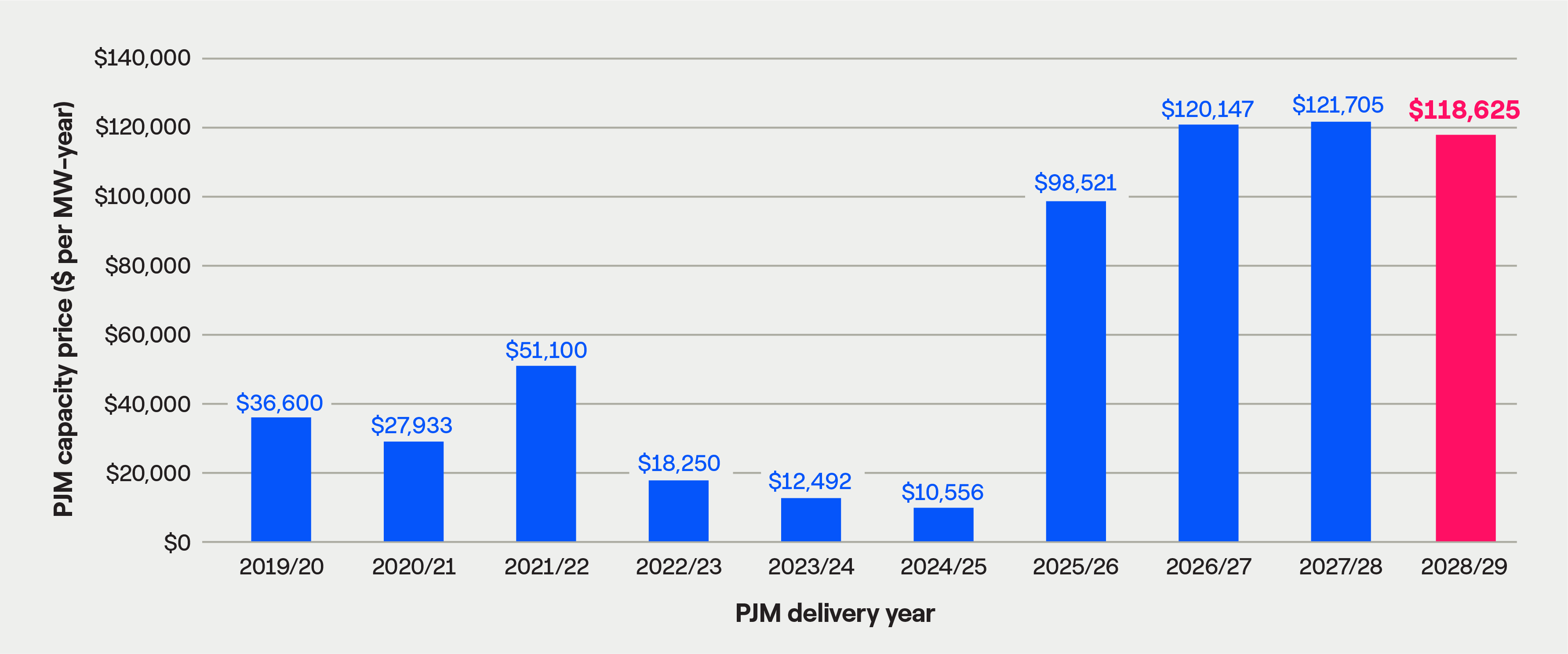
Source: PJM Interconnection
While these results provide some consistency to protect ratepayers from dramatic sticker shock, the cost of doing business remains high for companies in PJM. Retail capacity charges are expected to average approximately $110,000/MW-year as costs remain at near record levels for the fourth consecutive auction. Capacity charges are expected to average approximately 2.5¢/kWh for companies with a typical 50% load factor (peak demand is double average usage) – more than five times higher than in 2024/2025, when costs averaged approximately 0.5¢/kWh across PJM.
These prices only strengthen the value proposition for demand response. While capacity charges remain elevated, so too is demand response pricing. Businesses may not be able to control high capacity charges. But they can control how they respond to that pricing, and participating in demand response can be an effective way to offset rising energy costs.
70% higher pricing without the cap indicates grid conditions continue to tighten
Similar to prior auctions, PJM simulated the 2028/2029 results without a price cap. In this instance, the auction would have cleared more than 70% higher than the capped results – over $202,000/MW-year across PJM’s footprint, suggesting continued upward pressure on capacity prices. The simulation yielded even higher pricing in PJM’s Commonwealth Edison zone in northern Illinois – more than $280,000/MW-year.
The capped result, while 2.5% lower than the 2027/2028 auction, is simply due to the reduced cap price. It is not an indication that market conditions in PJM are improving. While the institution and extension of the pricing cap have kept consumer prices relatively stable over the past 3 auctions, they are masking the disconnect between supply and demand. PJM remains fundamentally supply-constrained.
For the second year in a row, PJM faces a reserve margin shortfall
Reserve margins are critical for grid operators like PJM because they provide an extra cushion to ensure the grid has sufficient supply during periods of exceptionally high demand – such as prolonged heat waves or cold spells – or when unexpected generation or equipment outages occur. PJM has been operating on slimmer margins in recent years as reserve margins have declined. This doesn’t necessarily mean PJM won’t be able to serve load when the grid is stressed – it just means that extra cushion is getting uncomfortably tight. PJM has been aiming for a comfortable 20% reserve margin.
This is the second consecutive auction in which PJM failed to meet their reliability requirement – they are approximately 6,831 MW short. As a result, the projected reserve margin is 14.4%, well below PJM’s target of 20%. Compared with the 2027/2028 auction, the reserve margin held steady at the same percentage, while the reliability shortfall slightly increased from 6,516 MW to 6,831 MW.
These results were affected by a load forecast that increased more than 1,300 MW from 2027/2028, largely driven by data center development.
“These numbers compound the alarm bells for a call to action in PJM,” FERC Chairman Laura Swett said during the agency’s monthly meeting on July 16, 2026. “Now we have yet another signal that partners across federal, state, and local levels have to work together to ensure reliable, affordable power amid the AI race and the nation’s reindustrialization and electrification.”
PJM will be organizing an additional auction mechanism, known as the Reliability Backstop Procurement, in the coming months aimed at resolving this multi-year reserve margin shortfall.
What resources cleared in the auction?
A total of 139,595 MW were offered in the 2028/2029 auction (up from 136,148 MW in 2027/2028), and 138,318 MW ultimately cleared. These figures signal continued constraint on the system and that PJM will require all available resources for extreme weather events, such as we saw in late June / early July.
In the 2028/2029 auction, PJM is once again relying on a diverse portfolio of resources to support grid reliability. The cleared mix consists of 46% natural gas, 20% nuclear, 18% coal, 5% demand response, 4% hydro, 2% wind, 2% oil, and 1% solar.
Choosing the right demand response provider has never been more important
As PJM enters another delivery year with record-high capacity prices, tightening reserve margins, and growing demand pressures, demand response remains one of the most effective tools available to help PJM quickly and effectively keep the grid in balance – and help businesses offset rising energy costs.
With all available demand response resources clearing the auction (7,017.4 MW in total) and demand response pricing remaining at historically elevated levels, businesses have a unique opportunity to turn operational flexibility into a new revenue stream while supporting grid reliability.
But capturing the full value of demand response requires more than simply enrolling in the program. PJM is calling events more frequently, and participating successfully requires a provider with the market expertise, technology, and operational support needed to maximize performance and navigate increasingly complex market conditions. Because it’s not only annual capacity payments on the table. There are market rule changes for this 2028/2029 delivery year: there will be a new penalty structure for some kinds of events and a likely reduction in the occurrence of audits.
With the right market insights, education, participation plan, and team by your side, you can confidently show up during demand response events and receive additional energy payments for your performance. That’s bonus money for showing up when PJM needs you. If the right provider doesn’t take the time to invest in your success, you could miss out on that money. You need to factor in more than just the revenue split your provider offers – check out our webinar to learn more.
Enel has decades of experience in the PJM demand response market and currently manages a portfolio of more than 3,000 commercial and industrial facilities across the region. Enel combines deep market knowledge, advanced energy management capabilities, and hands-on customer support to help organizations capture demand response revenue, manage rising capacity costs, and strengthen their overall energy strategy in a rapidly evolving power market.
As capacity markets continue to send strong price signals and PJM confronts ongoing resource adequacy challenges, businesses need a trusted partner to help them respond with confidence. Reach out to our team today to start the conversation and turn today’s market conditions into a revenue opportunity that strengthens your bottom line.
